Bringing Peruvian Craft Into Your Home: Colour, Pattern and the Hands Behind It
A lot of home decor advice tells you to take things away: fewer colours, fewer patterns, fewer objects. Our home pieces go the other way. They are about bringing colour, pattern and craft into a room, and about the people and places behind each piece. Here is how we think about it, and the pieces that tell our story.
Colour is the point
In Peru, colour is everywhere: on market stalls, on textiles, on the walls of houses and on the bags rice is sold in. Our home pieces carry that energy. Instead of asking a room to stay quiet, they give it something to say. One strong piece is often enough to change the feel of a whole wall.
Hand-embroidered wall hangings
Our hand-embroidered wall hangings are the pieces closest to our heart. They are embroidered by women across Peru who have practised their craft for many years. Working with them means paying fairly for that knowledge, so these techniques can keep being practised and passed on, and given room to evolve through new pieces.
Each hanging tells a small story, like El Guardián or El Mensajero. Some of our earlier pieces, such as El Baile and En el Mercado, have already found their homes, but they remain part of the story of how this collection began.
Soon, we will introduce a new collection of tapestries made with Tejiendo Esperanza, an organisation that helps keep traditional textile techniques alive while creating opportunities for the women who practise them.
The Costal hangings
Costal means sack in Spanish. Our framed Costal hangings take their inspiration from pre-Columbian motifs and from the printed sacks of everyday Peru, turning a humble material into a piece for the wall. Each carries a word or a feeling, like Tumbao or Mi Vida. Corazón and Con Amor, two of the first in the series, are currently sold out.
The Dama del Cao lamp
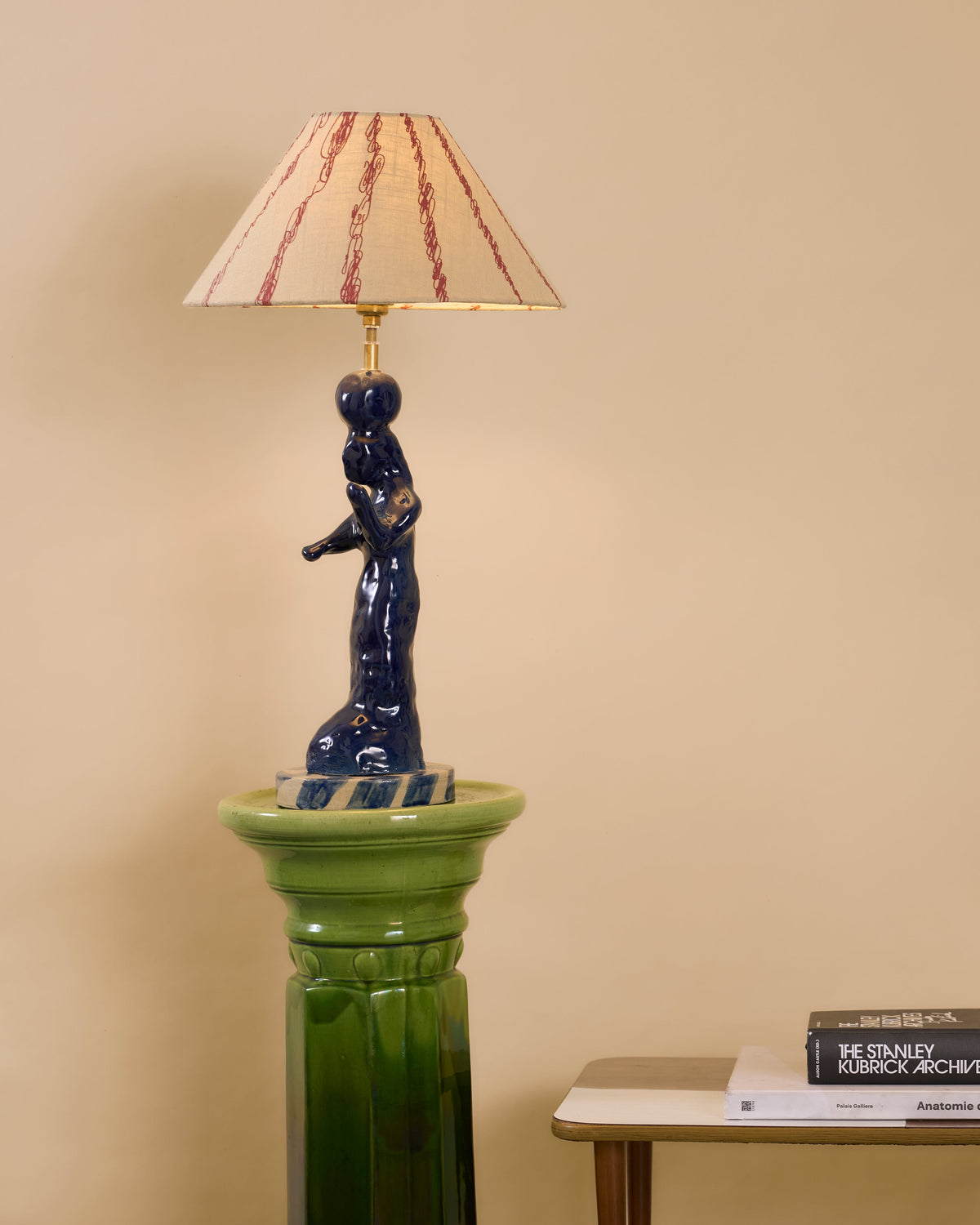
The Señora de Cao was a powerful woman of the Moche culture, whose remains were discovered in northern Peru in 2006. Her tattoos and her story inspired our Dama del Cao light shade, created with the artist Aileen Gavonel. The first edition is currently sold out, but it remains one of the pieces that best shows what Studio Afuera is about: an ancient Peruvian story, reimagined for a home today.
Plates, prints and sculptures
Craft does not have to stay on the wall. Our porcelain plates, like the Afuera plate, bring our artwork to the table. Our canvas prints are named after things we love from home: Causa, after the Peruvian dish, and Chévere, which means great, or cool. For a statement piece, the Juntos Afuera sculpture brings our idea of togetherness into three dimensions.
How to bring craft into a room
Start with one piece you love and build around it, rather than trying to match everything. Let a wall hanging take the main wall and keep the rest of the room simple enough to let it breathe. Mix textures: embroidery next to porcelain, linen next to wood. And let pieces from different places sit together. That is what a home full of stories looks like.
The hands behind each piece
Every piece in our home collection carries the work of someone: an embroiderer in Peru, an artist in London, a maker who has kept a technique alive for decades. When you bring one into your home, you bring that story with you.